Is Pilates Safe to Do After a Back Injury?

Pilates is a physical fitness system developed in the early 20th century by Joseph Pilates, a man who was inspired by his poor health as a child to study anatomy, yoga, Zen and the exercises of the Greeks and Romans. By the time he was 14, Pilates had developed such an impressive body that he modeled for anatomy charts. His later jobs included boxer, circus performer and fitness trainer.

pilatesBased on his studies and his personal experience, Pilates developed a system of exercises that he called Controlology, which is now called Pilates. The principles of Pilates are mind over matter, breathing, centering, concentration, control and precision.  The exercises, which can be performed on a mat or machines, aim to teach correct postural alignment of the spine and strengthen the deep torso muscles (core muscles).

Physical therapy and Pilates share many concepts, and many physical therapists are integrating Pilates into their rehabilitation programs. Physical therapy is the science of preventing, diagnosing and treating movement dysfunctions.  Physical therapy exercises focus mainly on muscle balance, postural alignment and, most importantly, function.

The Pilates machines are great for many patients because the system of ropes, pulleys, and springs can resist or assist movement in positions that decrease loads on the spine. This is safer and less painful than some other forms of exercise.

Pilates movement patterns can adapt to a variety of diagnoses, but they aren’t recommended for everyone. Pregnant women should only do Pilates under the supervision of an instructor with training in using Pilates during pregnancy. Some women experience separation of the abdominal muscles (diastesis) during pregnancy, and should avoid Pilates. Patients with an acute disc injury of the spine should complete core stabilization exercises first and then transition to Pilates exercises. While Pilates can help strengthen the back, if you’re being treated for a back injury, it’s best to consult with your doctor and physical therapist before starting a Pilates program.
Viscosupplements for Osteoarthritis

By Hector Mayo, PT

Osteoarthritis is a condition in which the cartilage in a joint breaks down. Consequently the bones may rub together, which leads to pain and stiffness. There is also a thinning of the synovial fluid, the slippery substance that cushions and lubricates the joint. As a result, the fluid doesn’t lubricate as effectively.

Treatment for osteoarthritis generally includes physical therapy and medicine that reduces pain and inflammation. A physical therapist can teach you exercises to reduce pain and improve strength, endurance, and range of motion. Advanced cases of osteoarthritis are sometimes treated with corticosteroids, and in severe cases, a surgeon may replace the damaged joint.

For patients with osteoarthritis of the knee that doesn’t respond to conservative treatment, doctors may inject artificial synovial fluid, which is also referred to as a viscosupplement. This fluid is available under various brand names, including Synvisc, Hyalgan, Supartz, Euflexxa and Orthovisc. These products are based on hyaluronic acid, which is one of the lubricating substances found in natural synovial fluid.

Treatment with viscosupplements requires a weekly injection,* from three to five times, depending on the brand’s formulation. Some patients feel relief from pain right away, but most report the greatest pain relief 8 to 12 weeks following the start of treatment. It is generally recommended that patients avoid putting a lot of weight on the legs for about 48 hours following an injection. This means temporarily refraining from activities such as jogging, tennis or heavy lifting.

While the Food and Drug Administration has approved viscosupplements for osteoarthritis of the knee only, they are being studied for effectiveness in treating arthritis in the shoulder, hip, ankle and the joint at the base of the thumb. Regulators in Europe have approved Synvisc for use in the knee, shoulder, hip and ankle. In December, 2007, a single-injection formulation, Synvisc-One, was approved in Europe to treat osteoarthritis of the knee, and the FDA is currently reviewing an application for approval of this treatment in the United States.*

(*update: The FDA approved Synvisc One in 2009.)

Shoulder Injuries and Tennis

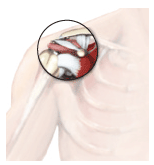
shoulderThe tennis serve and stroke are complex movement patterns demanding rhythmic coordination and timing of specific upper extremity muscles.  When a tennis player has poor flexibility, muscle imbalances or poor technique, faulty movement patterns can lead to shoulder injury.

The most common injury in tennis is impingement syndrome.  This is a narrowing of the space occupied by the rotator cuff tendons, under the acromion. The tendons are impinged, causing inflammation and pain.

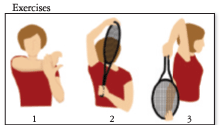
Tennis racquet exercisesAn excellent way to prevent injury is to do exercises that stretch the muscles and capsule in the back of the shoulder.  One way to do this is by grasping the elbow and pulling the arm across the body without shrugging the shoulder.  Another way is to hold the racket behind your back and move it up and down.

A physical therapist can evaluate whether muscle imbalances or poor mechanics have led to impingement syndrome. The therapist will then develop an appropriate treatment program.

Labral Hip Tears

A labral tear is a fairly common injury of the hip, but it is easy to misdiagnose. Sometimes a patient receives treatment for another condition such as a hip flexor strain or tendonitis, and when the pain doesn’t improve, further investigation reveals a torn labrum.

The hip labrum is a thin layer of cartilage that lines the hip socket and cushions the joint. The labrum can be torn by trauma, such as a car accident or a collision during a contact sport. Tears can also result from repetitive stress, especially from the twisting motions common in ballet, softball or golf. The labrum can be also be damaged by a degenerative condition such as arthritis. Symptoms may include pain, stiffness, a clicking sound and a catching sensation in the hip.

Many people with labral hip tears have a positive impingement sign. This means that groin pain occurs after the following test: as you lie on your back, your knee is brought toward your chest until the angle between your thigh and torso is 90 degrees, and then your upper leg is moved in and toward the opposite shoulder while downward pressure is applied at the knee. Magnetic resonance arthrography with contrast can diagnose most hip tears. The most accurate diagnosis comes from arthroscopic surgery, in which a tiny camera is used to view the labrum.

Moderate cases can be treated with rest and physical therapy. A physical therapist can teach you exercises to improve hip strength and stability. Your therapist can also evaluate your movements and show you how to avoid the ones that stress the hip. Some patients may also benefit from corticosteroid injections. If the pain is severe or does not respond to physical therapy, arthroscopic surgery is recommended. The surgeon may remove the torn area or repair the cartilage with sutures.

Knee Pain in Runners (Iliotibial Band Friction Syndrome)

Q: Why does the outside of my knee begin to hurt in the middle of my run?

A: Pain at the outside portion of the knee during running may be due to iliotibial band friction syndrome.  The iliotibial band (ITB) is a thick band of tissue on the outside of the thigh, extending from the hip to just below the knee.  It stabilizes the knee during running, and can become inflamed due to the knee’s repetitive motion.  The pain generally occurs during or after activity, and the area may become swollen and tender to the touch.

ITB syndrome may be caused by:

  • a change in training habits (e.g., increasing mileage too quickly)
  • running on a banked surface
  • structural abnormalities (e.g., flat feet, bow legs, uneven leg length)
  • muscle imbalances

Treatment generally involves rest from the aggravating activity, ice to reduce swelling, stretching the ITB, and strengthening the hip muscles.  It is important to consult a physical therapist to determine what is causing the syndrome, and to learn proper strengthening and stretching exercises.


How Do You Treat ACL Tears?

By Nancy Simpkins

A physical therapist works with a patient who is exercising.
A patient does exercises to strengthen muscles following ACL reconstruction surgery.

What do quarterback Tom Brady, downhill skier Lindsey Vonn, shooting guard Klay Thompson and soccer player Megan Rapinoe have in common? They have all torn an anterior cruciate ligament (ACL).

What is the ACL?

The ACL connects the tibia (shin bone) to the femur (thigh bone). A tear in this ligament can make the knee joint unstable or prone to giving way. Sudden, pivoting movements become difficult, and arthritis is more likely to develop.

How do you tear your ACL?

Many ACL tears happen after someone lands from a jump, changes direction rapidly, or suffers a blow to the knee. ACL tears are common in basketball, football, soccer and skiing.

A physical therapist works with a patient who is balancing on one leg.Women are more susceptible to ACL tears than men are, which may be due to anatomical differences and the effects of hormones on ligaments. Another factor is that women tend to use a more upright posture than men. Athletes who use a crouching posture are less likely to suffer ACL injuries. The ACL also weakens with age, and is more likely to tear in athletes over 40.

Symptoms and treatment of ACL tears

Symptoms of an ACL tear include a popping sound, sudden instability of the knee, pain and swelling. Initial treatment includes ice, and it’s important to keep weight off the knee to prevent further damage. If an athlete wants to continue in a high-impact sport, an ACL tear usually requires surgery, followed by physical therapy to strengthen the muscles surrounding the knee. For the knee to function in normal daily activities, physical therapy alone may be sufficient.


Take a Hike

hikingHiking is great exercise, but crossing uneven terrain poses a risk of injury, most commonly to the joints of the legs. Walking downhill can be hard on the knees and ankles, especially if you walk too fast or land too hard on your feet.

Hitting the ground too hard repeatedly can wear away articular cartilage, which lines the ends of the bones in your joints. This can lead to osteoarthritis. Improper downhill walking technique can also cause bursitis, which is inflammation of the fluid-filled sacs that cushion the joints. Going downhill too fast increases your risk of falls and ankle sprains.

The following steps can reduce the risk of hiking injuries:

It’s best to go downhill slowly, even if it feels more natural to go quickly.

Taking small steps can prevent the knees from flexing excessively.

A hiking stick allows your arm muscles to support some of your weight, taking pressure off your knees, and some people use ski poles for this purpose. Support is especially helpful if you’re carrying something heavy, such as a backpack. Studies have shown that one stick is sufficient when not carrying anything, but two sticks make it easier to keep your balance when carrying a load.

If the trail is wide enough, walking from side to side across the trail as you go down can reduce the effect of the slope on your knees.

Supportive hiking boots can reduce the risk of ankle sprains.

Consult a physical therapist to learn exercises that stretch and strengthen the muscles that support the hips, knees and ankles.

If a hiker experiences moderate to severe pain and swelling in the knee or ankle, it’s best to rest the leg, even if it’s necessary to cancel the rest of the hike. Ideally, ice should also be applied, but if none is available on the trail, it can be helpful to soak a cloth in cold water from a stream and wrap it around the injured joint. Hikers should carry an elastic bandage to wrap an injured area; compression can reduce swelling. Elevating the injury above the heart will help drain fluid and reduce swelling. These steps can be easily remembered by using the acronym RICE, which stands for rest, ice, compression and elevation.

Bursitis sometimes goes away after one to two weeks of rest, but treatment may involve draining the fluid, cortisone injections, or physical therapy to learn appropriate exercises and stretches. Treatment of arthritis can include medication, physical therapy and surgery.

Rock Climbing

People have been climbing rocks for centuries, but with hundreds of gyms now offering climbing walls, sport climbing is no longer limited to the outdoors. In 2006, Climbing Magazine estimated its readership at close to 121,000 people, and an earlier U.S. government study found that 7.4 million Americans had tried rock climbing.

Sport climbing requires strength, endurance, balance and flexibility, and it provides an excellent workout. However, frequent climbing can lead to overuse injuries, especially in the hands, wrists elbows and shoulders.

Common injuries include:

Climber’s finger: damage to the flexor tendon pulleys that encircle and support the tendons that cross the finger joints. Climber’s finger is caused by putting more weight on the fingers than they can support. Treatment may include rest, ice, anti-inflammatory medication and range-of-motion exercises.

Climber’s elbow: this usually refers to strain of the brachialis tendon, but it can also refer to medial epicondylitis or lateral epicondylitis. For all of these, treatment may include rest, ice, anti-inflammatory medication and range-of-motion exercises.

Rotator cuff injuries: these are more common in older climbers. The rotator cuff is a group of muscles and tendons that stabilize the shoulder. Treatment may include ice, rest, physical therapy and sometimes corticosteroid injections or surgery.

Strengthening the upper body can reduce the risk of injury. The following exercises can help:

Pull-ups can develop strength in the shoulder, back, stomach, forearms and grip. One-armed pullups are especially useful.

Fingers can be strengthened by squeezing a tennis ball, holding for five seconds and relaxing, then repeating 30 to 40 times.

Lateral raises can strengthen the shoulders. Standing with your feet about shoulder-width apart, hold a light weight in each hand. With your elbows slightly flexed, raise your arms out to the sides until they are at shoulder level, with your palms facing the floor. Slowly lower your arms, then repeat the sequence, doing three sets of ten repetitions each.

As with any exercise, it’s best to warm up and stretch before rock climbing, and to maintain overall conditioning. If you’re new to climbing, a lesson is always a good idea.