
Trigger Finger

By Marianne Pilgrim, OTR/L, CHT
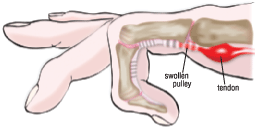
Trigger FingerHave you experienced a locking or catching sensation while trying to bend or straighten one of your fingers or thumbs? You may have developed trigger finger, also known as stenosing tenosynovitis.

The tendon that moves each finger is surrounded by a sheath (tenosynovium) that keeps the tendon lubricated. Both the tendon and sheath pass under ligaments that form a tunnel known as the A1 pulley.  Trigger finger occurs when inflammation or a nodule prevents the tendon from moving smoothly through the tunnel. The tendon can get stuck, and when it is finally released, the finger snaps like a trigger. This release is usually quite painful.

Symptoms of trigger finger may include the following: swelling on the palm side of the involved finger; a painful nodule on the palm; pain with movement or heavy gripping; joint stiffness; painful popping and clicking while bending and straightening the finger; and if left untreated, the inability to fully straighten the finger due to locking.

Trigger finger generally affects people between 40 and 60 years of age, and women more often than men.  The condition may result when repetitive or sustained gripping with fingers or pinching with the thumb causes inflammation of a tendon and its sheath. A history of the following diseases may be associated with an increased risk of trigger finger: diabetes, rheumatoid arthritis, carpal tunnel syndrome, De Quervain’s tenosynovitis, hypothyroidism, and Dupuytren’s disease.

De Quervain’s Tenosynovitis

Have you experienced pain and swelling near the thumb side of your wrist after increased activity?  You may have De Quervain’s tenosynovitis.  This condition is an inflammation of the thumb tendons and the sheaths that cover them.  It affects more women than men and generally occurs between the ages of 30 and 50.  De Quervain’s tenosynovitis may be caused by repetitive or sustained pinching or gripping, as in using a pen or pulling weeds. It can also be caused by holding heavy objects with the thumb facing up, as in lifting a pot by its handle or caring for a baby.  Other causes may include trauma to the side of the wrist, or a cyst.

The tendons that are involved in De Quervain’s tenosynovitis are the abductor pollicis longus and the extensor pollicis brevis, which pass through a tunnel near the thumb side of the wrist. Irritation of the tendons and the tunnel can cause swelling, pain and scar tissue. This can limit movement in the thumb and wrist.

Conservative treatment may include resting the tendons in a thumb splint, ultrasound and/or electrical stimulation to heal tissues and improve circulation, cold therapy to decrease pain and swelling, and techniques to reduce scar tissue. Your hand therapist can teach you exercises that strengthen muscles and allow the tendons to glide normally. The therapist can also provide education about changing daily activities to prevent recurrences.

If conservative treatment is not effective, your doctor may inject cortisone to the site of irritation, which usually reduces pain and swelling. In cases of severe or chronic swelling and pain that limits function in the thumb, surgery may be required to release the tunnel covering the tendons.  Hand therapy following surgery will focus on exercises of the thumb and wrist, scar management, muscle strengthening and proper body mechanics. Prompt treatment results in quicker improvement and better long-term results.