
Achilles Tendon Rupture

By Hector Mayo, PT

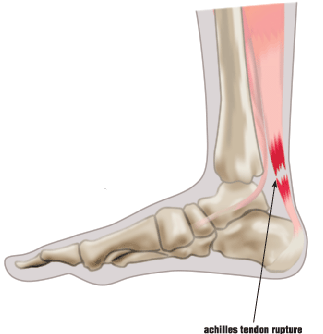
achilles tendonIf you feel a sudden pain at the back of your ankle, followed by an inability to move your foot normally, you may have ruptured your Achilles tendon. This tendon connects the calf muscles to the heel bone, and it is instrumental in allowing you to walk, run, and stand on your toes.

The Achilles tendon is most susceptible to rupture in people who take up exercise without proper conditioning, especially in sports that involve sudden starts and stops, such as tennis or basketball. The left leg tends to be affected more often than the right, probably because most right-handed people push off with the left leg during sports. Aging and lack of exercise both contribute to weakening of the tendon, which makes it more prone to injury. Ruptures are most common among men between the ages of 30 and 50.

Long-term inflammation of the tendon can also lead to rupture, and tight or weak calf muscles raise the risk. Other causes of rupture include running on hills or hard surfaces, and wearing shoes that don’t fit properly. Steroids, especially if injected directly into the tendon, are associated with an increased probability of Achilles tendon rupture. The use of fluoroquinolone antibiotics also raises the risk.

Treatment of a complete rupture usually includes surgery to repair the tendon, followed by wearing a cast, a splint or a walking boot. A partial rupture can often be treated without surgery. For all ruptures, patients should receive physical therapy, which will strengthen the leg muscles and the tendon, increase flexibility and restore full range of motion.

Is Pilates Safe to Do After a Back Injury?

Pilates is a physical fitness system developed in the early 20th century by Joseph Pilates, a man who was inspired by his poor health as a child to study anatomy, yoga, Zen and the exercises of the Greeks and Romans. By the time he was 14, Pilates had developed such an impressive body that he modeled for anatomy charts. His later jobs included boxer, circus performer and fitness trainer.

pilatesBased on his studies and his personal experience, Pilates developed a system of exercises that he called Controlology, which is now called Pilates. The principles of Pilates are mind over matter, breathing, centering, concentration, control and precision.  The exercises, which can be performed on a mat or machines, aim to teach correct postural alignment of the spine and strengthen the deep torso muscles (core muscles).

Physical therapy and Pilates share many concepts, and many physical therapists are integrating Pilates into their rehabilitation programs. Physical therapy is the science of preventing, diagnosing and treating movement dysfunctions.  Physical therapy exercises focus mainly on muscle balance, postural alignment and, most importantly, function.

The Pilates machines are great for many patients because the system of ropes, pulleys, and springs can resist or assist movement in positions that decrease loads on the spine. This is safer and less painful than some other forms of exercise.

Pilates movement patterns can adapt to a variety of diagnoses, but they aren’t recommended for everyone. Pregnant women should only do Pilates under the supervision of an instructor with training in using Pilates during pregnancy. Some women experience separation of the abdominal muscles (diastesis) during pregnancy, and should avoid Pilates. Patients with an acute disc injury of the spine should complete core stabilization exercises first and then transition to Pilates exercises. While Pilates can help strengthen the back, if you’re being treated for a back injury, it’s best to consult with your doctor and physical therapist before starting a Pilates program.

Viscosupplements for Osteoarthritis

By Hector Mayo, PT

Osteoarthritis is a condition in which the cartilage in a joint breaks down. Consequently the bones may rub together, which leads to pain and stiffness. There is also a thinning of the synovial fluid, the slippery substance that cushions and lubricates the joint. As a result, the fluid doesn’t lubricate as effectively.

Treatment for osteoarthritis generally includes physical therapy and medicine that reduces pain and inflammation. A physical therapist can teach you exercises to reduce pain and improve strength, endurance, and range of motion. Advanced cases of osteoarthritis are sometimes treated with corticosteroids, and in severe cases, a surgeon may replace the damaged joint.

For patients with osteoarthritis of the knee that doesn’t respond to conservative treatment, doctors may inject artificial synovial fluid, which is also referred to as a viscosupplement. This fluid is available under various brand names, including Synvisc, Hyalgan, Supartz, Euflexxa and Orthovisc. These products are based on hyaluronic acid, which is one of the lubricating substances found in natural synovial fluid.

Treatment with viscosupplements requires a weekly injection,* from three to five times, depending on the brand’s formulation. Some patients feel relief from pain right away, but most report the greatest pain relief 8 to 12 weeks following the start of treatment. It is generally recommended that patients avoid putting a lot of weight on the legs for about 48 hours following an injection. This means temporarily refraining from activities such as jogging, tennis or heavy lifting.

While the Food and Drug Administration has approved viscosupplements for osteoarthritis of the knee only, they are being studied for effectiveness in treating arthritis in the shoulder, hip, ankle and the joint at the base of the thumb. Regulators in Europe have approved Synvisc for use in the knee, shoulder, hip and ankle. In December, 2007, a single-injection formulation, Synvisc-One, was approved in Europe to treat osteoarthritis of the knee, and the FDA is currently reviewing an application for approval of this treatment in the United States.*

(*update: The FDA approved Synvisc One in 2009.)

De Quervain’s Tenosynovitis

Have you experienced pain and swelling near the thumb side of your wrist after increased activity?  You may have De Quervain’s tenosynovitis.  This condition is an inflammation of the thumb tendons and the sheaths that cover them.  It affects more women than men and generally occurs between the ages of 30 and 50.  De Quervain’s tenosynovitis may be caused by repetitive or sustained pinching or gripping, as in using a pen or pulling weeds. It can also be caused by holding heavy objects with the thumb facing up, as in lifting a pot by its handle or caring for a baby.  Other causes may include trauma to the side of the wrist, or a cyst.

The tendons that are involved in De Quervain’s tenosynovitis are the abductor pollicis longus and the extensor pollicis brevis, which pass through a tunnel near the thumb side of the wrist. Irritation of the tendons and the tunnel can cause swelling, pain and scar tissue. This can limit movement in the thumb and wrist.

Conservative treatment may include resting the tendons in a thumb splint, ultrasound and/or electrical stimulation to heal tissues and improve circulation, cold therapy to decrease pain and swelling, and techniques to reduce scar tissue. Your hand therapist can teach you exercises that strengthen muscles and allow the tendons to glide normally. The therapist can also provide education about changing daily activities to prevent recurrences.

If conservative treatment is not effective, your doctor may inject cortisone to the site of irritation, which usually reduces pain and swelling. In cases of severe or chronic swelling and pain that limits function in the thumb, surgery may be required to release the tunnel covering the tendons.  Hand therapy following surgery will focus on exercises of the thumb and wrist, scar management, muscle strengthening and proper body mechanics. Prompt treatment results in quicker improvement and better long-term results.


Yoga Safety

Yoga began more than four thousand years ago, but it has become increasingly popular over the last several years. Hatha yoga is the physical component of yoga, and it involves performing a series of poses while controlling your breathing. Yoga has many benefits, including increased flexibility, strength, balance and endurance. Many say yoga helps to decrease stress and anxiety as well. However, if you are new to yoga, you may get injured if you force your body into poses it is not ready for. Maintaining proper technique and avoiding simple mistakes can help you perform yoga injury free.

Yoga post

Here are some simple tips for those beginning yoga:

Find a good instructor. The instructor should always ask if any participants have had any previous injuries or have had any surgery. The instructor should modify poses for those with previous injuries, and certain poses should be avoided. Ask the instructor about his or her yoga training; how many hours did it include? Is the instructor certified?

Consult with your doctor about whether yoga is right for you, especially if you have any injuries or medical conditions.

Warm up! Do about ten minutes of warm-up exercise, such as riding a stationary bike, to get the blood flow- ing to the muscles and to lubricate the joints.

Protect your back. Keep your knees slightly bent and make sure to hinge from your hips when you bend forward from a standing position. Also, do not overarch your lower back.

Yoga poseProtect your knees. Do not lock your knees when standing. When kneeling, place a cushion under your knees to avoid excess pressure on the knees.

Protect your neck. Keep your neck in alignment with the rest of your spine whenever possible.

Listen to your body. If something hurts or doesn’t feel right, do not push yourself.


Soccer and Knee Injuries

By Nancy Simpkins

Soccer is the most played sport in the world, and the number of people taking to the fields in the U.S. is gradually increasing. Although soccer is considered to be safer than football, it’s popularity means that there are many soccer injuries. Among soccer players, the knee is one of the most commonly injured areas, second only to the ankle.

Nearly half of soccer’s knee injuries occur during tackling. These injuries include sprains and strains, meniscus tears, osteoarthritis, patellofemoral pain, and patella subluxations and dislocations.

Another common soccer injury is a rupture of the anterior cruciate ligament (ACL). This ligament runs from the front of the tibia (shin bone) back and up to the outer femur (thigh bone). It prevents the tibia from moving forward, which keeps the knee stable. Injuries to this ligament can occur as a result of landing from a jump, slowing down while abruptly changing direction on a planted foot, or from an opponent striking the outer part of the leg during a slide tackle. A rupture of the ACL needs to be repaired surgically.

Physical therapy before ACL surgery can decrease inflammation, swelling and pain. It can also improve range of motion and strength, and normalize gait. The athlete will also attend physical therapy postoperatively, and depending on the athlete’s progress, the physician will recommend waiting six to twelve months before the athlete returns to competition.

Meniscus tears, which are tears to the shock-absorbing cartilage in the knee, are associated with ligament injuries and can require more aggressive rehabilitation. A comprehensive strengthening program is often sufficient treatment, but if not, arthroscopic surgery can repair the tear.